
Prayagraj’s Lost Rivers , Beneath the sacred waters of Prayagraj’s Triveni Sangam lies one of India’s most enduring mysteries—the story of rivers that once flowed freely but now exist only in mythology, ancient texts, and perhaps, deep underground channels. For thousands of years, pilgrims have gathered at this confluence believing they’re bathing where three rivers meet, even though only two are visibly flowing. This isn’t mere religious imagination; it’s a fascinating intersection of faith, geology, archaeology, and environmental history that continues to intrigue scientists and devotees alike.
The legend of the Saraswati River—once mighty, now invisible—dominates these stories, but it’s far from the only tale of lost waterways that shaped Prayagraj’s sacred geography. Ancient texts describe a landscape dramatically different from today’s, with multiple rivers and tributaries that have since vanished, changed course, or been absorbed into larger water systems. Understanding these lost rivers means diving into layers of history, both geological and cultural, that reveal how profoundly landscapes can transform while spiritual significance remains constant. Let me take you on a journey through time, beneath the surface, to explore what lies hidden under Prayagraj’s famous waters.
The Sacred Geography of Triveni Sangam
Understanding the Three River Confluence
The Triveni Sangam represents the meeting point of three rivers: the Ganga flowing from the Himalayas, the Yamuna originating from Yamunotri, and the Saraswati—the mysterious third river that Hindus believe joins the confluence underground. This triple merger creates what Hinduism considers the most sacred of all tirthas (pilgrimage sites), where the spiritual merit of bathing multiplies exponentially compared to bathing in a single holy river.
Stand at the Sangam today and you’ll clearly see two distinct water colors meeting—the muddy brown of the Ganga and the slightly greenish-blue of the Yamuna, creating a visible line where they converge. This dramatic visual evidence of two rivers meeting makes the claim of a third, invisible river all the more intriguing. Is it purely symbolic? A metaphor for spiritual truths? Or does geological reality support the ancient belief? The answer, as with many things in India, interweaves faith and science in complex ways that resist simple categorization.
The Visible and the Invisible
The concept of a river flowing invisibly underground challenges modern sensibilities but fits perfectly within Hindu philosophical frameworks that accept multiple levels of reality—gross and subtle, material and spiritual. The Saraswati’s invisible presence at Prayagraj embodies this worldview, where what cannot be seen might be more real and significant than visible phenomena.
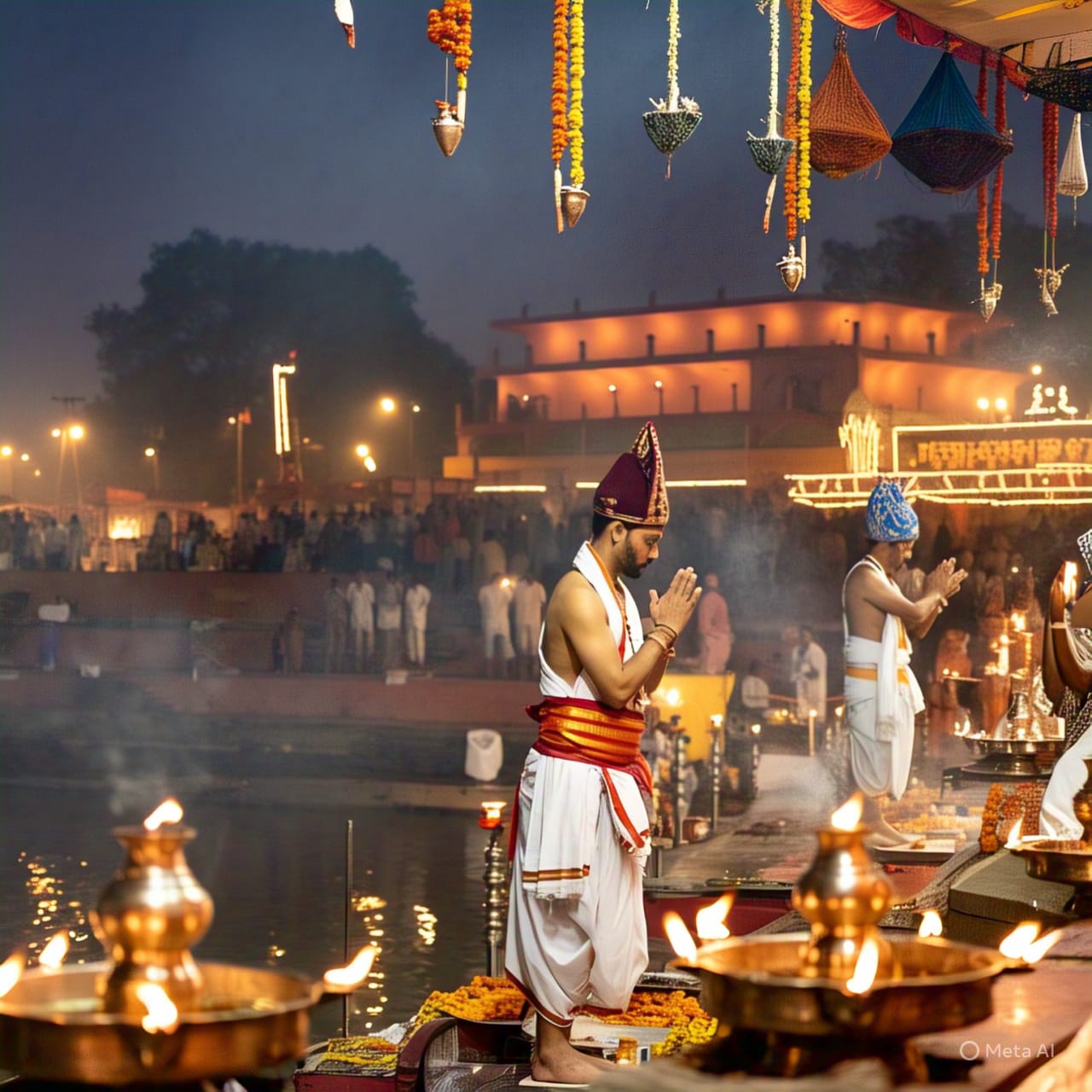
For pilgrims approaching the Sangam, this invisible river represents faith itself—believing in what cannot be directly perceived. Priests conducting rituals invoke all three rivers equally, making offerings to Saraswati with the same reverence as to her visible sisters. This practice, maintained across centuries, reflects a cultural continuity that transcends geological changes. Whether the Saraswati flows underground today or exists purely in sacred imagination, its presence shapes spiritual experiences at the Sangam as powerfully as the two rivers you can actually see and touch.
The Saraswati River: Mythology Meets Geology
Ancient Texts and References to Saraswati
The Saraswati appears prominently in India’s oldest texts, the Vedas, where she’s described not just as a river but as a goddess of knowledge, wisdom, and purity. The Rigveda—composed roughly 3,500 years ago—contains numerous hymns praising the Saraswati, describing her as a mighty river flowing from the mountains to the sea, sustaining settlements along her banks and providing life-giving water to ancient civilizations.
These aren’t vague poetic references but detailed descriptions suggesting the Saraswati once rivaled or exceeded the Ganga in importance. The Rigveda calls her “Saraswati, the best of rivers, the best of mothers, the best of goddesses.” Later texts like the Mahabharata reference the Saraswati’s confluence with the Ganga and Yamuna at Prayag, establishing the Triveni Sangam’s sacred status. The question that has puzzled scholars for centuries: were these texts describing an actual physical river, or were they always speaking metaphorically?
Vedic Descriptions of the Mighty River
Vedic hymns provide surprisingly specific geographical details about the Saraswati’s course. They describe her flowing from the Himalayas through regions that correspond to modern-day Punjab, Haryana, and Rajasthan before reaching the sea. Settlements along her banks prospered, and she appears to have served as a crucial water source for the Harappan civilization that flourished in northwestern India around 3300-1300 BCE.
The texts praise her abundance: “Pure in her course from the mountains to the ocean, alone of rivers, Saraswati hath listened.” This description of a snow-fed Himalayan river flowing all the way to the sea doesn’t match any currently existing river in that region, lending credence to the theory that the Saraswati was once a major river system that subsequently disappeared or dramatically changed course. The Vedic people clearly knew this river intimately, suggesting they lived along its banks during the period these texts were composed.
Scientific Search for the Lost Saraswati
Modern scientists have taken up the challenge of determining whether the mythological Saraswati corresponds to a real, now-extinct river system. Since the 1980s, researchers using satellite imagery, ground-penetrating radar, and geological surveys have uncovered compelling evidence of a major paleochannel—an ancient dried riverbed—running through northwestern India roughly along the route described in Vedic texts.
These investigations reveal a river system that once flowed vigorously but began drying up around 4,000-3,000 years ago, coinciding roughly with the decline of the Harappan civilization. The timing isn’t coincidental—the disappearance of this major water source likely contributed to the civilization’s collapse and the migration of populations eastward toward the still-flowing Ganga-Yamuna system. Archaeological sites along the paleochannel show evidence of once-thriving settlements that were abandoned as water sources disappeared.
Satellite Imagery and Archaeological Evidence
Satellite imagery from organizations like ISRO (Indian Space Research Organisation) has proven particularly valuable in tracing the Saraswati’s ancient course. These images reveal patterns in vegetation, soil moisture, and topography that indicate an ancient river channel running from the Shivalik Hills through Haryana and Rajasthan, potentially connecting to what are now seasonal rivers like the Ghaggar.
Archaeological excavations along this paleochannel have discovered numerous Harappan-era settlements, suggesting this region supported dense populations when water flowed reliably. The settlement pattern—clustered along the identified ancient riverbed—provides strong circumstantial evidence that the Saraswati wasn’t merely mythological but a geographical reality that shaped one of the world’s earliest urban civilizations. However, whether this ancient river actually reached Prayagraj and joined the Ganga-Yamuna confluence remains subject to debate and ongoing research.
Theories About Saraswati’s Disappearance
Tectonic Shifts and Climate Change
The most scientifically accepted explanation for the Saraswati’s disappearance involves tectonic activity in the Himalayan region combined with climate change during the mid-to-late Holocene period. The theory suggests that the Saraswati was fed by Himalayan glaciers through tributaries that were captured by other river systems due to tectonic shifts—particularly the uplift of the Aravalli range and changes in river gradients.
Around 4,000-5,000 years ago, these tectonic movements redirected the Saraswati’s main tributaries—possibly the Sutlej and Yamuna—causing them to flow into other river systems instead. Simultaneously, climate change brought reduced monsoon rainfall to northwestern India, diminishing the river’s flow. The combination of losing glacial meltwater tributaries and receiving less rainfall proved fatal to the river system, which gradually dried up, leaving only seasonal streams and underground aquifers.
River Capture and Geological Transformations
River capture—when one river system “steals” the tributaries of another through geological processes—appears to have played a crucial role in the Saraswati’s demise. Evidence suggests the Yamuna, which according to Vedic descriptions might have originally been a Saraswati tributary, shifted eastward to join the Ganga system instead. Similarly, the Sutlej—potentially another major Saraswati tributary—redirected westward to join what’s now the Indus system.
These river captures didn’t happen overnight but occurred gradually over centuries through processes like tectonic uplift changing river gradients, making it more hydraulically favorable for water to flow in new directions. For the human populations dependent on these rivers, the changes would have been observable within lifetimes—elders remembering more abundant water than younger generations experienced, settlements gradually relocating toward more reliable water sources, and the slow transformation of a life-giving river into intermittent streams and eventually dry channels.
When Did the Saraswati Stop Flowing?
Dating the Saraswati’s disappearance involves synthesizing evidence from multiple sources—archaeological site abandonment patterns, geological dating of sediments in the paleochannel, and climatic data from various proxies. The consensus suggests the major drying occurred between 4,000-3,000 years ago, though the process was gradual rather than sudden.
This timeline places the Saraswati’s decline during the later Vedic period, which might explain why earlier Vedic texts describe her so vividly while later texts speak of her disappearance or underground flow. The shift from physical river to invisible, sacred presence may reflect the actual historical transformation that populations witnessed—their great river disappearing but remaining alive in cultural memory and religious practice. By the time Sanskrit epics like the Mahabharata were being composed (roughly 2,000-3,000 years ago), the Saraswati had already become the invisible river of legend, though living memory of her physical presence likely persisted in oral traditions.
Other Lost Waterways of Prayagraj
Ancient Tributaries and Forgotten Streams
Beyond the famous Saraswati, Prayagraj’s landscape has witnessed the disappearance of numerous smaller rivers, streams, and tributaries over millennia. Ancient texts and medieval accounts reference waterways that no longer exist or have been absorbed into the urban landscape. The process of cities growing and rivers changing has been ongoing for thousands of years, continuously reshaping sacred geography.
Some of these lost waterways were seasonal streams that flowed during monsoons but dried during summer—a common pattern in northern India. Others were year-round tributaries that shifted course, merged with other systems, or dried up due to changing rainfall patterns. The pandas (priests) of Prayagraj maintain genealogical records going back centuries, and within these bahis (record books) occasionally appear references to bathing places and ghats along waterways that no longer exist, tantalizing hints of a more complex hydrological past.
The Vanished Channels of Historical Records
Historical records from medieval travelers and Mughal-era documents occasionally mention rivers and streams around Prayagraj that don’t correspond to current geography. Some of these might be alternative names for existing waterways, but others clearly describe water bodies that have since vanished. Colonial-era maps sometimes show channels and streams that later maps don’t include, suggesting relatively recent geographical changes.
One example involves references to streams that once flowed through what’s now Allahabad Fort’s location. These channels were likely redirected or filled during various construction projects over centuries. Similarly, some historical accounts describe Sangam’s precise location differently than where it’s currently identified, suggesting either the confluence point has shifted slightly due to changing river courses, or different criteria were used to identify the sacred meeting point. These vanished waterways remind us that landscape isn’t static—it evolves constantly, though at timescales that make changes almost imperceptible within individual lifetimes.
Archaeological Evidence of Ancient Water Systems
Excavations Revealing Old River Courses
Archaeological excavations in and around Prayagraj have occasionally uncovered evidence of ancient water channels, embankments, and water management systems that don’t correspond to current river positions. These findings suggest that the local hydrological system has shifted considerably over millennia. Layers of riverine sediments found in unexpected locations indicate where water once flowed but no longer does.
Such archaeological evidence provides crucial objective data to balance textual sources and religious traditions. When excavations reveal ancient settlements positioned along what are now dry channels, it confirms that water once flowed there, supporting the broader narrative of lost rivers and shifted waterways. The challenge lies in dating these remains accurately and correlating them with textual references to create comprehensive pictures of how Prayagraj’s sacred geography has evolved.
Ancient Settlements Along Disappeared Rivers
The pattern of ancient settlement distribution offers another window into lost rivers. Archaeological surveys show concentrations of ancient habitation sites following lines that don’t correspond to current river courses but make perfect sense if ancient waterways existed there. People settle near reliable water sources; when you find ancient settlement clusters along what are now dry routes, it strongly suggests rivers once flowed there.
In Prayagraj’s broader region, this pattern appears repeatedly. The distribution of painted grey ware sites, early historic settlements, and even some Harappan-era findings suggests water courses that have since disappeared or dramatically shifted. These settlements weren’t randomly positioned—they followed the logic of water availability, trade routes along rivers, and agricultural potential of river valleys. Understanding this settlement archaeology helps reconstruct the hydrological past that shaped religious and cultural developments.
Harappan Connections and River Networks
The Harappan civilization (also called Indus Valley Civilization) extended far beyond the Indus River itself, with major settlement clusters in the Saraswati-Ghaggar region. The civilization’s decline around 1900-1300 BCE correlates with the drying of the Saraswati system, suggesting this river was crucial to supporting the urban sophistication that characterized Harappan culture.
Some researchers propose that as the Saraswati dried, populations migrated eastward toward the still-flowing Ganga-Yamuna system, potentially bringing cultural and religious practices that influenced the development of what became classical Hinduism. If this migration hypothesis is correct, Prayagraj’s emergence as a supreme sacred site might reflect the transfer of religious significance from the lost Saraswati to the surviving Ganga-Yamuna confluence. The invisible Saraswati at Prayagraj would then represent not just geological history but cultural memory—a way of maintaining continuity with spiritual traditions established along a river that physical reality no longer supported.
Religious Significance of Invisible Waters
Why Hindus Believe in the Underground Saraswati
The belief in an underground Saraswati at Prayagraj isn’t arbitrary superstition but flows from sophisticated theological concepts within Hinduism. The religion recognizes multiple levels of reality—what’s visible to ordinary perception represents only one dimension of existence. Sacred geography operates simultaneously on physical, subtle, and causal planes, with invisible rivers possessing equal or greater significance than visible ones.
This framework allows believers to maintain that even if the Saraswati no longer flows on the surface (and many devout Hindus accept this geological reality), she continues flowing underground or in subtle dimensions inaccessible to ordinary observation. The Saraswati’s association with knowledge and wisdom—she’s the goddess of learning, arts, and music—makes her invisible nature symbolically appropriate. Just as true knowledge exists within rather than on surface appearances, the Saraswati flows hidden beneath, accessible to those with spiritual insight.
Ritualistic Acknowledgment of Hidden Rivers
Rituals performed at the Sangam explicitly invoke all three rivers equally. Priests conducting puja ceremonies offer waters and prayers to Ganga, Yamuna, and Saraswati without distinction between visible and invisible. Pilgrims taking their holy dip believe they’re bathing in three rivers simultaneously, gaining triple the spiritual merit. This ritual acknowledgment maintains the Saraswati’s presence in lived religious practice regardless of physical visibility.
The mantras recited during Sangam rituals name all three rivers, describe their divine qualities, and request blessings from each. These invocations, preserved across generations, create continuity with ancient periods when the Saraswati perhaps flowed visibly. The ritual language hasn’t changed to reflect geological reality—it maintains the original formulation, suggesting that for religious purposes, the Saraswati’s presence is understood as eternal and unchanging despite surface-level physical transformations.
The Spiritual Power of Unseen Sacred Waters
Hindu philosophy often attributes greater power to subtle, invisible realities than to gross, visible phenomena. In this framework, the invisible Saraswati might be considered more spiritually potent than her visible sister rivers precisely because she transcends ordinary perception. Accessing her blessings requires faith, spiritual sensitivity, and devotion—qualities valued in religious practice.
This concept parallels how sacred sites throughout Hinduism often feature hidden elements accessible only to initiates or those with spiritual preparation. Secret caves, underground passages, concealed idols—these hidden aspects enhance rather than diminish sacred power. The Saraswati’s invisibility at Prayagraj fits this pattern, making the Sangam not just a confluence of physical rivers but a meeting point of visible and invisible, material and spiritual, demonstrable and faith-based dimensions of reality.
Geological Studies and Modern Research
Ground-Penetrating Radar and River Detection
Modern technology offers tools to investigate underground river channels without extensive excavation. Ground-penetrating radar (GPR), which sends electromagnetic pulses into the ground and analyzes reflected signals, can identify buried structures, including ancient river channels filled with different sediments than surrounding soil. Several studies have applied such technologies around Prayagraj and the broader Ganga-Yamuna doab region.
These investigations reveal complex aquifer systems underground, including channels that likely represent ancient surface rivers now buried beneath sediment accumulated over millennia. Some researchers claim these findings support the underground Saraswati theory, though the scientific community debates whether these represent the legendary Saraswati specifically or simply the normal complex hydrogeology expected in a region with such long fluvial history.
What Scientists Have Discovered Beneath Prayagraj
Studies using various geological methods have mapped underground water channels in Prayagraj’s subsurface. These include paleochannels (ancient dried riverbeds) and active aquifer systems that don’t correspond to current surface rivers. The presence of these underground water systems provides a geological basis for the concept of underground rivers, even if the exact identification with the mythological Saraswati remains speculative.
Research published by the Geological Survey of India and various academic institutions has identified multiple subsurface channels in the region. Some of these show characteristics consistent with being ancient surface rivers—certain sediment types, particular mineral compositions, and flow directions that make sense for former surface drainage systems. Whether any of these specifically represent the Vedic Saraswati or are simply the expected complex geological legacy of a dynamic river system remains actively debated among researchers.
Aquifer Systems and Ancient Channels
The distinction between aquifer systems (underground water-bearing rock formations) and actual underground river channels matters for understanding what might exist beneath Prayagraj. Aquifers are common worldwide and represent groundwater moving slowly through porous rock rather than flowing like a surface river. Underground river channels—where water flows through defined channels beneath the surface—are rarer and usually occur in limestone regions where caves form.
What likely exists beneath Prayagraj is primarily aquifer systems, some following paths of ancient surface rivers whose channels became buried and now conduct groundwater. This represents a geological phenomenon rather than an actual underground river in the sense of a subterranean channel through which water flows rapidly. However, this distinction matters more to geologists than to religious practitioners for whom the spiritual reality of the Saraswati’s underground presence transcends such technical classifications.
The Yamuna’s Changing Course Through History
Historical Documentation of River Movements
While the Saraswati’s disappearance dominates lost river discussions, the Yamuna itself has shifted course multiple times throughout history, though less dramatically. Historical records and colonial-era maps show slight variations in the Yamuna’s exact channel and the Sangam’s precise location. Rivers naturally migrate laterally over time through processes like erosion and sediment deposition, constantly reshaping their banks and channels.
Medieval travelers’ accounts sometimes describe the Sangam’s location in ways that don’t precisely match its current position, suggesting the confluence point has moved slightly. During major floods, rivers can shift significantly, cutting new channels and abandoning old ones. The Yamuna’s tendency to shift has probably contributed to periodic relocations of ghats and sacred bathing places, with religious authorities redefining where the most auspicious bathing should occur based on changed river positions.
How Prayagraj’s Geography Has Shifted
The broader geography of Prayagraj has transformed considerably over documented history. The city’s expansion, particularly during Mughal and British periods, reshaped landscapes significantly. The construction of the Allahabad Fort, for instance, likely involved redirecting or filling smaller water channels. Colonial-era cantonment development altered drainage patterns. The city’s modern growth has paved over countless streams and nallahs (channels) that once drained into the main rivers.
These human interventions combine with natural processes—river meandering, flood plain development, sediment deposition—to create a constantly evolving landscape. Comparing historical maps from different eras reveals how the rivers’ relative positions, the shape of the doab (land between rivers), and the location of key features have shifted. While the Ganga and Yamuna themselves remain flowing where they have for thousands of years, their precise channels and the detailed geography around them show continuous evolution.
Impact on Kumbh Mela and Pilgrimage Traditions
How Lost Rivers Shape Sacred Bathing Rituals
The concept of bathing at a triple confluence rather than merely a double confluence profoundly shapes Kumbh Mela and daily pilgrimage rituals at Prayagraj. The belief that you’re immersing yourself where three sacred rivers meet—even though only two are visible—amplifies the spiritual significance and the perceived merit gained. This makes Prayagraj’s Sangam superior to other confluences where only two rivers meet visibly.
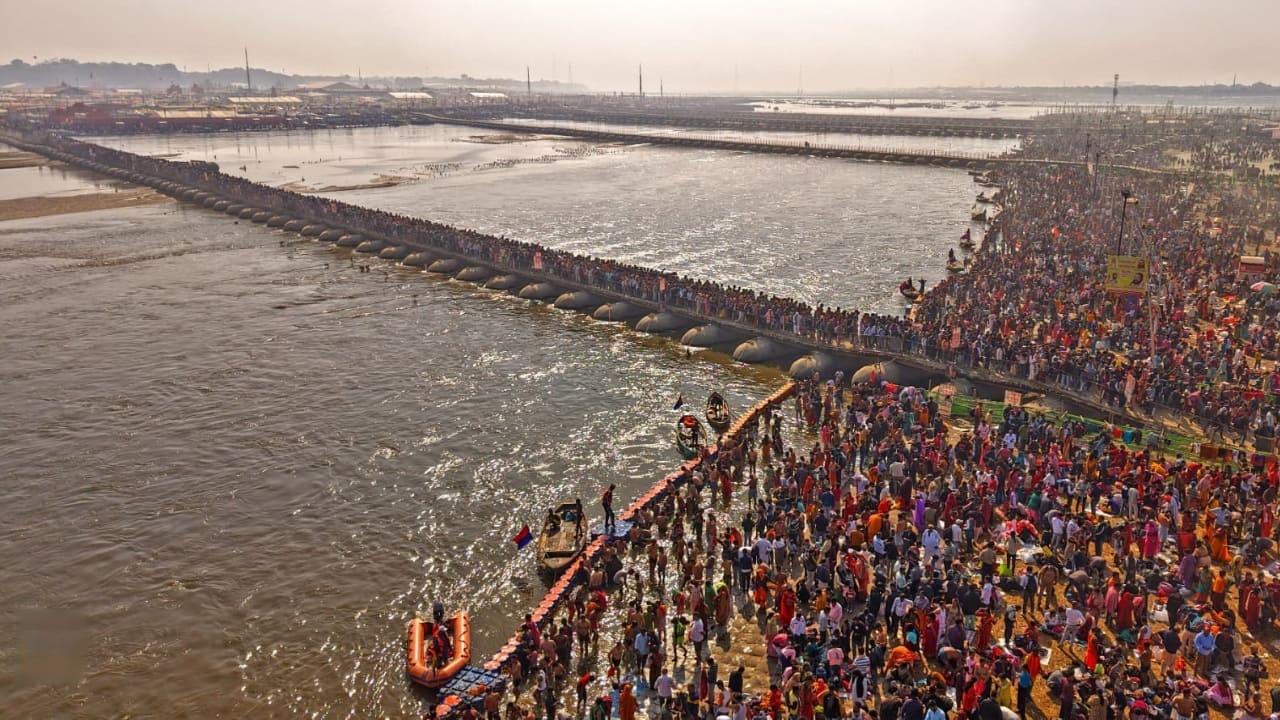
The Kumbh Mela’s status as the world’s largest religious gathering stems partly from this unique triple confluence status. Pilgrims believe that bathing here on auspicious dates washes away not just sins of this lifetime but multiple lifetimes, providing spiritual benefits unattainable elsewhere. The invisible Saraswati’s presence isn’t a minor detail but fundamental to why Prayagraj holds supreme importance among Hindu pilgrimage sites.
The Concept of Antaradhaan (Hidden Presence)
Hindu religious vocabulary includes the term “antaradhaan,” meaning “hidden” or “disappeared from view.” The Saraswati is said to be antaradhaan at Prayagraj—not absent, but present in a hidden manner. This concept extends beyond simple invisibility to suggest a deliberate divine concealment, where the goddess Saraswati chose to flow underground, making her presence accessible only to those with devotion and faith.
This theological framework transforms a geological problem (why isn’t there a visible third river?) into a spiritual teaching about the nature of divine reality and the importance of faith. The antaradhaan Saraswati becomes a test and opportunity—those who bathe with genuine belief in her invisible presence receive her blessings, while those who skeptically see only two rivers miss the deeper spiritual reality. This interpretation maintains religious coherence while acknowledging physical reality.
Local Legends and Folk Stories
Tales Passed Down Through Generations
Prayagraj’s local communities maintain rich oral traditions about the rivers, including stories explaining why the Saraswati disappeared. One popular legend describes how the Saraswati, proud of her purity and beauty, was cursed by a sage to flow underground as punishment for her vanity. Another tale suggests she voluntarily went underground to avoid being polluted by increasing human settlements along her banks, maintaining her sacred purity by flowing hidden.
These stories, told by grandparents to children and repeated by priests to pilgrims, serve multiple functions. They provide narrative explanations for geological mysteries, teach moral lessons about humility and purity, and maintain cultural continuity by connecting current generations to ancient traditions. Whether historically accurate or not, these legends shape how locals and pilgrims understand and experience the Sangam’s sacred geography.
Pandas’ Oral Histories of Changing Rivers
The pandas—hereditary priests who maintain family genealogies and guide pilgrims through rituals—possess oral histories spanning generations. Their families have served pilgrims for centuries, and within these lineages, stories persist about how the rivers have changed. Some pandas tell of great-great-grandfathers describing the Sangam slightly differently, or of major floods that altered riverbanks and required relocating sacred bathing spots.
These oral histories, while not scientifically rigorous, offer valuable perspectives on environmental change observed across multiple human generations. When pandas describe their ancestors noting changes in water levels, shifts in river channels, or the drying of certain streams, they’re providing multi-generational environmental observations that can complement scientific studies. Their knowledge, embedded in religious practice and family tradition, preserves information that written records might miss.
Stories of Divine Intervention and Curses
Many local legends involve divine intervention in river courses. Stories tell of particular deities blessing or cursing rivers, causing them to appear or disappear, change course or flow more abundantly. One story describes how sage Agastya once drank the entire ocean, and various rivers including the Saraswati had to hide underground to avoid being consumed. Another legend claims Lord Brahma performed a great yajna (fire sacrifice) at Prayagraj that was so powerful it caused the Saraswati to dive underground to cool her waters.
These mythological narratives, while not literal geological explanations, reflect cultural processes of making sense of landscape changes through available frameworks—divine action rather than tectonic shifts. They also ensure that even dramatic environmental changes get integrated into ongoing religious traditions rather than disrupting them. The river disappeared? There’s a sacred story explaining why. The confluence shifted? Divine will determined the new location. This narrative flexibility has allowed Prayagraj’s sacred geography to remain constant in religious significance despite physical transformations.
Comparing Prayagraj with Other Sacred Confluences
Why Triveni Sangam Remains Most Sacred
India features numerous river confluences considered sacred, including the confluence at Devprayag (where the Alaknanda and Bhagirathi meet to form the Ganga), Rudraprayag, Karnaprayag, and others. However, Prayagraj’s Triveni Sangam maintains supreme status primarily because of the third, invisible river. Two-river confluences, while sacred, cannot match the spiritual power attributed to a triple confluence.
This ranking system within sacred geography shows how the Saraswati’s invisible presence, far from being a weakness or embarrassment, actually enhances Prayagraj’s religious importance. If the Saraswati were merely absent, Prayagraj would be just another double confluence. Her invisible, underground presence elevates the site to a unique category, making it the king of tirthas. The geological mystery becomes theological treasure, central to maintaining Prayagraj’s preeminent position in Hindu pilgrimage hierarchies.
Other Indian Sangams and Their Rivers
Examining other sacred confluences highlights what makes Prayagraj unique. Devprayag, where the Ganga is considered to truly begin, features two clearly visible rivers of different colors meeting dramatically in Himalayan mountains—spectacular and sacred, but straightforwardly physical. Kurnool’s confluence of Krishna and Tungabhadra in southern India represents another important sangam but again involves only two visible rivers.
Haridwar and Varanasi, while supremely sacred Ganga-side cities, aren’t confluences at all but single-river sites. They derive sanctity from the Ganga herself and from mythological events associated with those locations, but they cannot claim the confluence status that makes sangams particularly powerful. Prayagraj’s combination—two visible, one invisible—creates a unique category that religious tradition recognizes as supremely auspicious, unreplicable at any other location.
Environmental Changes and River Evolution
How Rivers Naturally Change Over Millennia
Understanding that rivers naturally change courses over geological time helps contextualize the lost Saraswati and other vanished waterways without requiring supernatural explanations. Rivers are dynamic systems constantly reshaping landscapes through erosion, sediment deposition, and response to tectonic activity. A river flowing in one channel today might, over thousands of years, shift to a completely different route.
This natural dynamism means that the landscape of 5,000 years ago—when the Saraswati likely flowed vigorously—looked quite different from today’s geography. Climate changes alter rainfall patterns, affecting which rivers flow perennially versus seasonally. Glacial retreat and advance change mountain hydrology, affecting river sources. Tectonic activity in active regions like the Himalayas and their foothills can shift river gradients enough to redirect entire drainage systems. What happened to the Saraswati, while dramatic, fits normal patterns of river evolution over millennia.
Human Impact on River Systems
While natural processes explain most ancient river changes, human activity increasingly affects river systems over the past few thousand years. Deforestation alters rainfall absorption and runoff patterns. Agricultural irrigation diverts water from rivers. Dam construction changes flow regimes. Urban development paves over streams and alters natural drainage. In Prayagraj’s case, while the Saraswati’s ancient disappearance predates significant human environmental impact, later centuries of human activity have further modified local water systems.
The smaller streams and tributaries that have vanished from Prayagraj’s geography in historical times likely disappeared partly due to human activity—urban expansion filling channels, wells and irrigation reducing surface flow, and drainage patterns altered by construction. This human dimension to lost rivers reminds us that the hydrological changes shaping sacred geography aren’t purely ancient history but continue today, raising questions about how future generations will experience sites like the Sangam if current environmental trends persist.
Visiting the Sangam Today: What Pilgrims Experience
Seeing the Two Rivers Meet
Modern pilgrims visiting Prayagraj witness a visually striking phenomenon: the distinct meeting of two rivers with noticeably different water colors. The Ganga’s muddy brown water meets the Yamuna’s clearer, slightly greenish-blue water, creating a visible boundary line where they converge. Boat operators take pilgrims to the exact confluence point, where you can observe this color difference directly and even collect water from each river separately before they fully mix.
This dramatic visual evidence of two rivers meeting makes the experience tangibly real in ways that enhance rather than diminish the invisible third river’s mystique. You can see two rivers clearly, providing empirical confirmation of at least part of the tradition. The third river requires faith rather than sight, making the experience blend observable physical reality with spiritual belief in a way that characterizes much of Hindu religious practice.
Believing in the Third Invisible River
For many pilgrims, the invisible Saraswati represents the most significant of the three rivers precisely because connecting with her requires faith and devotion rather than simple observation. The Ganga and Yamuna are there for anyone to see, believer or skeptic alike. The Saraswati reveals herself only to those who approach with proper spiritual preparation and belief. This distinction makes her presence a marker of genuine devotion rather than mere tourism.
Pilgrims often describe feeling the Saraswati’s presence even without seeing her—a sense of completeness to the confluence, an extra dimension of sanctity beyond what two visible rivers alone could provide. Whether this represents genuine spiritual perception, psychological expectation, or simple faith matters less than the experiential reality for believers. The bathing ritual completed with full conviction in all three rivers’ presence creates profound spiritual satisfaction that visible evidence alone might not achieve.
Religious guides and pandas actively cultivate this sense of the invisible Saraswati’s presence through their narration, ritual conduct, and the mantras they recite. By naming all three rivers repeatedly, describing their qualities, and treating the invisible river with equal reverence to visible ones, they create an experiential framework where pilgrims genuinely feel they’re bathing in a triple rather than double confluence. This ritualized attention transforms potential doubt into devotional certainty, demonstrating religion’s power to shape experienced reality.
Conclusion
The story of Prayagraj’s lost rivers—particularly the vanished Saraswati—represents far more than geological curiosity or religious mythology. It’s a profound example of how landscapes, beliefs, and human cultures interweave across millennia, creating sacred geographies that persist even as physical realities transform. The invisible Saraswati flowing beneath or beyond ordinary perception embodies the Hindu understanding that ultimate reality transcends surface appearances, that faith perceives truths invisible to empirical observation alone.
Modern science’s investigation of paleochannels, ancient river systems, and changing hydrology adds fascinating dimensions to these ancient traditions without either confirming or disproving the religious significance believers find at the Sangam. Geological evidence of a once-mighty river system that dried thousands of years ago validates that the Vedic Saraswati wasn’t pure invention, while the question of whether that ancient river literally flows underground today or exists in spiritual dimensions remains beautifully unresolved—a mystery that both scientists and devotees can appreciate from their different perspectives.
For the millions who gather at Prayagraj’s Triveni Sangam, particularly during the spectacular Kumbh Mela, these geological and historical complexities enrich rather than diminish the experience. Understanding that real rivers have disappeared, reappeared, and shifted courses over millennia adds depth to the faith that maintains the Saraswati’s invisible presence. The confluence of visible and invisible, physical and spiritual, empirical and faithful creates a sacred geography as layered and complex as the sediments beneath the Sangam’s waters—each layer telling stories of transformation, continuity, loss, and eternal return.
FAQs
1. Is there any scientific evidence that the Saraswati River actually exists underground at Prayagraj?
Scientific studies have identified paleochannels (ancient dried riverbeds) and complex aquifer systems in the broader region that once corresponded to a major river system, likely the Vedic Saraswati. However, there’s no conclusive evidence of an actual flowing underground river channel specifically at Prayagraj’s Sangam. What exists beneath the surface are aquifer systems—groundwater moving through porous rock formations, some following paths of ancient surface rivers. While this provides geological basis for underground water presence, it differs from a literal underground river channel. The scientific and religious perspectives operate on different levels—geology identifies ancient water systems; faith maintains the sacred presence of goddess Saraswati flowing in subtle dimensions.
2. When did the Saraswati River disappear, and what caused it?
Geological and archaeological evidence suggests the Saraswati system began drying between 4,000-3,000 years ago, with the process occurring gradually rather than suddenly. The disappearance resulted from a combination of tectonic activity causing river capture (where the Saraswati’s major tributaries like the Yamuna and possibly the Sutlej shifted to other river systems) and climate change bringing reduced monsoon rainfall to northwestern India. These changes transformed what was once a mighty Himalayan-fed river into seasonal streams and eventually dry channels, though some water continued flowing underground through aquifer systems. The timeline roughly corresponds with the Harappan civilization’s decline, suggesting the river’s disappearance significantly impacted ancient populations.
3. Why do Hindus consider Prayagraj’s Sangam more sacred than other river confluences?
Prayagraj’s Triveni Sangam is considered supremely sacred because it’s believed to be where three rivers meet—the Ganga, Yamuna, and the invisible Saraswati—rather than just two visible rivers. This triple confluence is unique in Hindu sacred geography. The number three holds special significance in Hindu cosmology, and bathing at a point where three sacred rivers converge is believed to provide exponentially greater spiritual merit than bathing in a single river or even a two-river confluence. The invisible nature of the Saraswati, rather than diminishing the site’s importance, actually enhances it by requiring faith and devotion to perceive, making the experience more spiritually significant than simple physical observation.
4. Are there other rivers besides the Saraswati that have disappeared from Prayagraj’s geography?
Yes, numerous smaller tributaries, streams, and water channels have disappeared or been redirected in Prayagraj’s region over millennia. Some were seasonal streams that dried up due to changing rainfall patterns; others were absorbed into urban development as the city expanded. Historical records and pandas’ oral traditions occasionally reference waterways that no longer exist. The process of rivers changing course, minor tributaries drying up, and urban expansion filling or redirecting smaller water channels has been ongoing for thousands of years. While the Saraswati represents the most dramatic and religiously significant lost river, the broader hydrological history involves numerous smaller-scale transformations that collectively reshaped the sacred landscape.
5. Can visitors actually see where two different colored waters meet at the Sangam?
Yes, one of the most striking aspects of visiting Prayagraj’s Sangam is clearly seeing two distinctly colored waters meeting—the Ganga’s muddy brown water and the Yamuna’s comparatively clearer, slightly greenish-blue water create a visible boundary line where they converge. This phenomenon is best observed from boats that take pilgrims to the actual confluence point in the middle of the river. The color difference results from the rivers’ different sources, the types of sediment they carry, and their flow characteristics. This visual evidence of two rivers clearly meeting provides powerful empirical confirmation that makes the tradition of a third, invisible river all the more intriguing—you can verify two rivers with your own eyes, while the third requires faith.